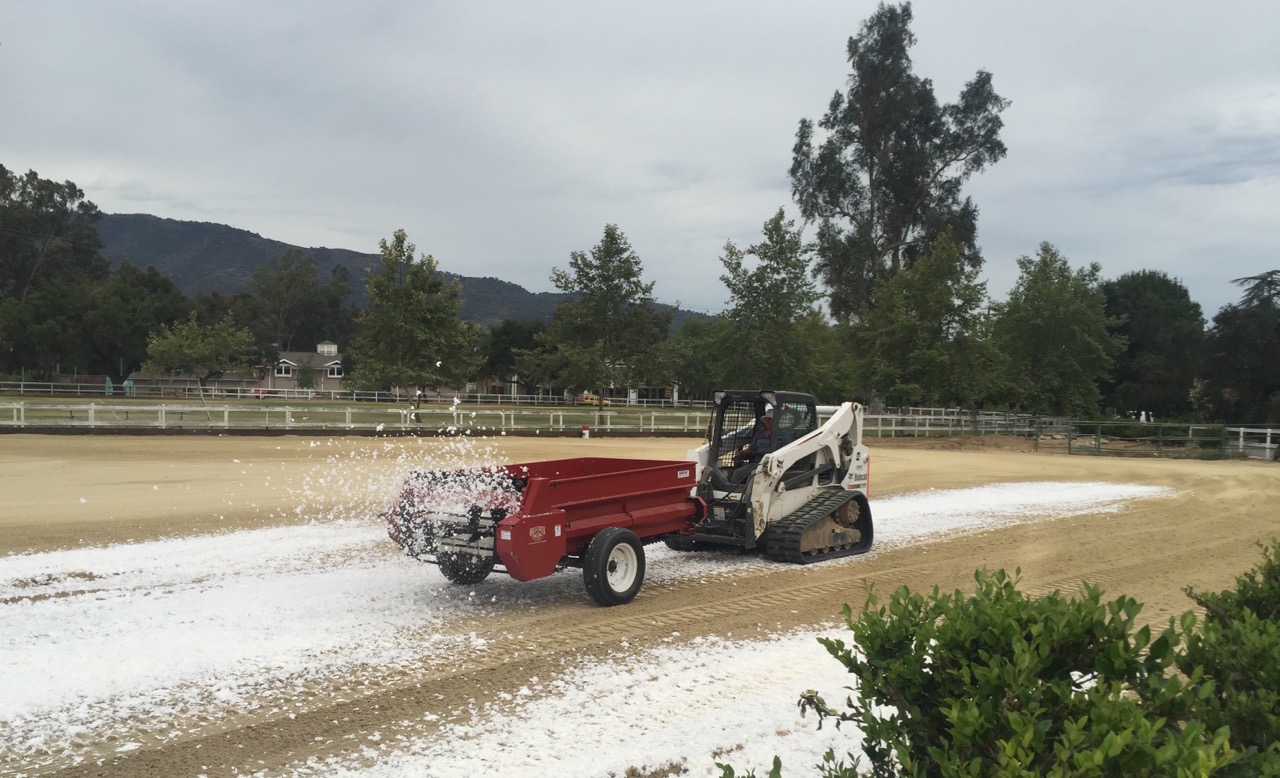

As the mercury hit 90-plus degrees this summer, a thick layer of fluffy white material blanketed the equestrian arena at Ojai Valley School and left the distinct impression that it had just snowed.
In fact, the material layered across the riding arena at the Lower Campus was part of a significant water-savings project launched by the school to replace fine sand with a state-of-the-art irrigation system and new geotextile footing material that is expected to dramatically cut the school’s water use, saving about 500,000 gallons of water a year.
The move is directly in response to the ongoing California drought and continues the school’s commitment to environmental sustainability. It is also a significant improvement for the school’s renowned equestrian program, as few schools or boarding stables have embraced such conservation measures.
“OVS has emerged as a leader in the independent school community with its pursuit of environmental sustainability,” said OVS President/CEO Michael J. Hall-Mounsey. “These include dramatically reducing our water usage, incorporating green-building practices in new building projects, and embracing solar technology.”
Three years ago, OVS installed a 1,001-panel 274-kilowatt solar array that produces more than 95% of the electricity at the Upper Campus. For more than a year, food waste from the dining hall at the Lower Campus has been composted through a partnership with Harrison and Sons.
More recently, the school has begun the process of converting lighting fixtures to LED and installing high efficiency HVAC systems. It has also taken dramatic steps to reduce its water use on both campuses, replacing grassy areas with mulch and drought-tolerant plants, installing weather-based controllers, and optimizing irrigation.
“We installed network-connected irrigation controllers that respond to local weather conditions at the Upper and Lower Campus athletic fields at both campuses,” said John Wickenhaeuser, Director of Technology and Sustainability. “Additionally we have reduced watering rates on the fields to achieve a 40% overall reduction in water use, exceeding the current state requirements.”
Perhaps the most visible project for the greater Ojai community is what the school has done at the Lower Campus equestrian arena – removing fine dusty sand and replacing it with the new footing made from a mixture of quartz sand and polyester and synthetic materials.
Historically, water reduction has presented a challenge for the equestrian program due to the need to mitigate dust created when elementary and middle school students ride in the arena. In accordance with an Ojai city ordinance, the dust must be kept to a minimum for safety and that has traditionally been accomplished by watering the arena.
Several months ago, Equestrian Director Stephanie Gustafson began researching alternatives to further minimize water use while maintaining a safe and healthy environment for students, horses, staff, and the broader community.
“The best option for equine safety and environmental sustainability is to add a geotextile footing material,” Gustafson said. “This is the top-of-the line in terms of material used at premier equestrian venues, and further distinguishes OVS as a blue-ribbon equestrian program.”